

Encapsulation Equipment That Drives Capsule Filling Performance
In high volume manufacturing, efficiency isn’t a choice – it’s a requirement. That’s why companies invest in advanced encapsulation equipment to save costs, reduce downtime, and increase throughput. This article covers modern capsule filling technologies, key buying features, and real-world performance results, including a case study that shows how one upgrade increased output by 6x and paid for itself in under 9 months.
Why Efficient Encapsulation Matters in Modern Manufacturing
Encapsulation is key in pharmaceutical and nutraceutical manufacturing. It ensures exact dosing, protects ingredients from moisture and oxygen, and maintains product stability. As consumer expectations and regulatory standards get tighter, manufacturers must deliver at scale – something manual methods can’t.
Modern encapsulation equipment automates the filling and sealing process with precision, minimizes human error, reduces waste, and lowers labor costs. The result is better product quality, faster production cycles, and higher profits, making encapsulation a cornerstone of any high-performing manufacturing line.
Different Types of Capsule Fillers
Encapsulation equipment comes in various formats to meet different production needs. Capsule filling machines—standard in pharmaceutical and nutraceutical manufacturing—are available in manual, semi-automatic, and fully automatic models. Manual options are suitable for low-volume applications, while fully automatic systems are designed for high-speed, high-precision output.
Capsule Filling Machines: Manual vs. Semi-Auto vs. Automatic
A brief overview of the different types of capsule filling machines, emphasizing throughput, labor cost, unit cost, accuracy, and maintenance requirements.
| Factor | Manual Capsule Filler | Semi-Auto Capsule Filler | Automatic Capsule Filler |
|---|---|---|---|
| Throughput | ~3k caps/hr | 10k–25k caps/hr | 50k–150k caps/hr |
| Labor $ | High (manual loading/filling) | Moderate (manual loading, automated filling) | Low (fully automated process) |
| Unit $ | Low investment; high per-unit cost | Moderate investment; moderate per-unit cost | High initial investment; low per-unit cost |
| Accuracy | Varies (depends on operator skill) | Moderate (± 1–2 mg) | High (± 0.3 mg) |
| Downtime | Simple maintenance | Regular maintenance | Regular maintenance |
| Table Notes: Chart comparing throughput, labor cost, unit cost, accuracy, and downtime of manual, semi-automatic, and automatic capsule filling machines. Throughput and accuracy vary depending on the operator’s skill and capsule size. Unit cost includes both investment and operational costs — Data source: Index Capsule Fillers. | |||
What to Look for in Encapsulation Equipment
When evaluating encapsulation machines, focus on features that impact consistency, speed, and long-term ROI:

High-precision dosing systems are key to minimizing overfill and meeting regulations—0.5mg overfill at 20,000 capsules per hour results in $15,000 per year in waste.
Look for machines with real-time monitoring, automatic capsule rejection, and modular design for easy cleaning and maintenance.
Durable materials and self-diagnostic features reduce downtime and service costs.
Scalability is important for growing businesses. Choose systems that can scale up to higher output without having to replace the entire line.
Operational Gains from Modern Automation
Modern encapsulation machines automate critical steps, such as capsule filling, sealing, sorting, and rejection, enabling consistent output of tens of thousands of capsules per hour. This reduces manual intervention, lowers labor requirements, and improves product uniformity—all essential for compliance and quality assurance.
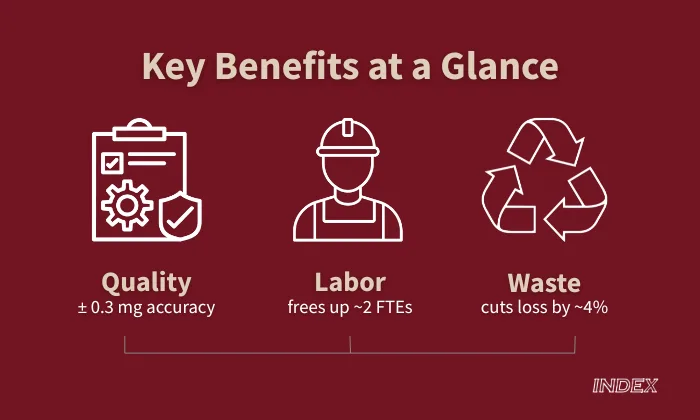
Automation also cuts changeover times and minimizes dosing errors, resulting in fewer product defects and less material waste. The combination of precision, speed, and repeatability allows manufacturers to scale without sacrificing efficiency, making automation one of the most impactful levers for improving throughput and reducing operational costs.
ROI of Capsule Filler Machines: 1 Million Capsules per Day
Cost, labor, and machinery needed to produce 1 million capsules daily, comparing manual, semi-automatic, and automatic capsule filling machines.
| Factor | Manual | Semi-Auto | Automatic |
|---|---|---|---|
| Daily Capacity per Machine | 24,000 caps | 140,000 caps | 800,000 caps |
| Machines Needed | 42 | 7 | 2 |
| Initial Investment | $12,600 | $70,000 | $550,000 |
| Total Daily Labor Cost (at $25/hr) | $9,450 (378 hrs) | $1,750 (70 hrs) | $500 (20 hrs) |
| Labor Cost per Capsule | $0.0095 | $0.0018 | $0.0005 |
| Facility Footprint | High | Moderate | Low |
| Payback Period | 12 months + | ~9 months | ~4.5 months |
| Table Notes: Cost, labor, and machine requirements to produce 1 million capsules daily, comparing manual, semi-automatic, and automatic capsule filling machines. Calculations use median machine capacity and a labor rate of $25 per hour; real-world results vary by model, efficiency, and setup. Payback period reflects conservative estimates, factoring daily labor savings and practical conditions. — Data Source: Index Capsule Fillers. | |||
Case Study – From Bottleneck to Breakthrough
Illustrative Scenario (modeled on average Index customer data)
To show the real impact of modern encapsulation equipment, the next section walks through an illustrative scenario that tracks a line stuck at 20,000 caps/hour and the results after a weekend retrofit. The numbers reveal how one upgrade can turn a chronic bottleneck into a profit engine.
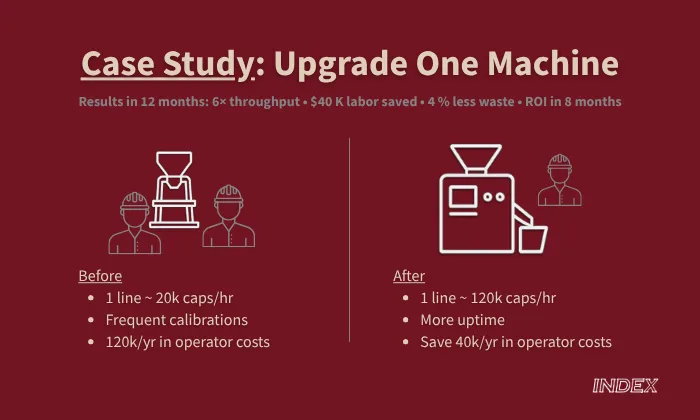
A nutraceutical company operating three capsule filling lines faced recurring downtime and calibration issues, with Line 2 limited to 20,000 capsules per hour.
Labor and troubleshooting costs exceeded $120,000 annually.
Over the weekend, the team retrofitted Line 2 with the INDEX K120i, a fully automatic capsule filler rated at 120,000 caps/hour to meet demand without adding shifts or headcount.
The machine’s advanced servo drives and real-time monitoring enabled ±0.3 mg fill-force precision, eliminating the need for manual calibration.
Within 12 months, throughput increased 6×, labor costs dropped by $40,000, and overfill waste was reduced by 4%, saving $20,000 in ingredients.
The machine paid for itself in 8.3 months, transforming Line 2 from a bottleneck into a high-speed production asset.
Maintenance and Care for Encapsulation Equipment
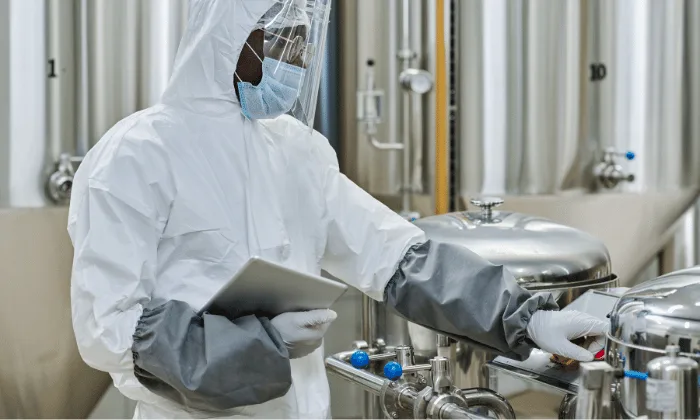
Regular maintenance is crucial for maximizing uptime and extending the lifespan of encapsulation equipment. Daily cleaning—especially in pharmaceutical and nutraceutical environments—prevents contamination and keeps machines running efficiently.
Regular maintenance is crucial for maximizing uptime and extending the lifespan of encapsulation equipment. Daily cleaning—especially in pharmaceutical and nutraceutical environments—prevents contamination and keeps machines running efficiently.
Operators should follow manufacturer guidelines for inspecting dosing systems, replacing worn seals, and lubricating key components. Many modern machines feature self-diagnostic alerts that help detect issues before they escalate.
Structured maintenance programs and operator training reduce unplanned downtime, improve safety, and ensure consistent performance across shifts, making proactive care a non-negotiable part of reliable production.
Documentation You Can Rely On: Index backs every capsule filler with clear, engineer-ready documentation—exploded-view parts diagrams, calibration protocols, and step-by-step IQ/OQ/PQ guides—so your team can troubleshoot fast and stay audit-ready. Our IQ/OQ templates translate validation into a 48-hour, audit-ready checklist, keeping safety teams satisfied without slowing down the launch.
Need Help on Site? Our certified field technicians average < 24-hour response times and handle start-up, commissioning, and emergency visits, and every Index filler ships with a signed factory QC report plus an on-site technician sign-off, so your line begins day-one production with verified settings and zero loose parts.
Avoid Start-up Delays: Order the recommended spare-parts kit with your machine so any seal or dosing ring can be swapped in minutes, not days.
Innovation and the Future of Encapsulation Equipment
"Generative AI and big data analytics are transforming pharmaceutical manufacturing and supply chain management.”
CPHI Pharma Trends 2024 Report
The encapsulation industry is evolving rapidly, driven by advances in automation, robotics, and artificial intelligence. Next-generation machines offer adaptive control systems that monitor fill weight in real-time, reduce overfill, and predict maintenance needs using sensor data.

Flexible, modular designs are gaining traction, enabling manufacturers to switch formulations more quickly and scale up without requiring major equipment overhauls. Wear-resistant materials, such as nitride-hardened cams, improve machine longevity, while microencapsulation techniques are expanding their applications in pharmaceuticals, food, cosmetics, and agriculture.
These innovations redefine efficiency, enabling manufacturers to produce more sophisticated, customized products, such as Firmapress®, while reducing waste and operational costs.
Key Takeaways
Encapsulation equipment is no longer a back-end operational choice—it’s a strategic asset that impacts efficiency, product quality, and profitability. Manufacturers who invest in precision, automation, and scalability confidently position themselves to meet rising market demand.
As the industry shifts toward more innovative, faster, and more flexible solutions, staying current with equipment trends isn’t optional—it’s essential. If you’re evaluating how to improve throughput, reduce costs, or streamline production, now is the time to assess your equipment and process constraints.
Want expert insight on your equipment setup? Our team is ready to help. For over 30 years, Index has offered USA-made capsule filling equipment and on-site customer service, including installation, training, maintenance, and parts, to keep you running smoothly 24/7. Talk to an expert now.
FAQs (Frequently Asked Questions)
What is encapsulation equipment?
Encapsulation equipment is a machine that fills and seals active ingredients into capsules or coatings. Found in pharmaceuticals, nutraceuticals, food supplements, and cosmetics, these machines ensure accurate dosing, protect sensitive materials from moisture and oxygen, and enhance product stability and bioavailability.
What is encapsulation in a drug delivery system?
Encapsulation in drug delivery is enclosing active pharmaceutical ingredients (APIs) into a protective shell. This process allows accurate dosing, shields ingredients from degradation, supports controlled release, improves therapeutic effect, and patient compliance.
How much does a capsule filling machine cost?
Costs vary based on output, features, and automation. Manual machines typically cost less than $3,000; semi-automatic machines range from $10,000 to $25,000, while fully automatic machines exceed $50,000. High-speed precision machines used in pharmaceutical production, however, are over $100,000 but provide precision, efficiency, and integrated quality controls.
Should I buy used encapsulation machines?
Buying used can be cost-effective, especially when scaling up. But you need to verify the machine’s condition, maintenance history, and compliance with regulatory standards. Work with reputable sellers and look for warranties or rebuild guarantees to minimize risk.
Should I rebuild an existing encapsulation machine?
If the frame and core components are sound, rebuilding can extend machine life at a fraction of the cost of new equipment. Upgrading controls, dosing systems, and worn parts can improve performance, output, and compliance without requiring new operator training or layout changes – partner with experienced rebuild specialists to ensure quality and long-term ROI.
How does encapsulation equipment integrate with pharmaceutical production lines?
Encapsulation machines are often integrated with downstream systems such as capsule sorting, sealing, inspection, and packaging. Automation allows seamless transitions between stages, reducing contamination risk and manual handling. Integration with MES (Manufacturing Execution Systems) also allows real-time monitoring, traceability, and compliance with regulatory standards.
What’s the difference between IQ and OQ?
Installation Qualification (IQ) checks that the capsule filler is installed to spec, utilities connected, frame levelled, and software and safety features verified. Operational Qualification (OQ) proves the machine operates within spec, fill weight, vacuum levels, and alarm responses during controlled test batches. Do both before production and you’ll meet regulatory requirements, avoid start-up issues, and have an audit-ready record for engineering and compliance.
What if I need a refresher on capsule filling terms?
Read “Capsule Filling Terms for Manufacturing Professionals,” where we cover the key terms for capsule filling, equipment, and processes to help you communicate to improve performance.