
A group of white colored capsules resting on a blue surface.

Dosator vs Tamping Pin: Which Dosing Method Fits Your Capsule Filling Process?

Whenever a pharmaceutical or nutraceutical manufacturer is in the market for a fully automatic capsule filling machine, they encounter a choice between two types of powder dispersion: tamping pin vs. dosator. While both technologies have existed for decades, the way they approach the physics of powder handling in capsule filling is very different. Understanding the tamping pin and dosator technologies is critical; if the wrong type is chosen for your product’s specific powder formulation, it can result in weight variation, rejected batches, and lower Overall Equipment Effectiveness (OEE).

Table of Contents

Why Powder Behavior Determines the Right Dosing System

Powder behavior is the main factor that determines whether a dosator or tamping pin system will work better for your product. Even if two powders look similar, they can act very differently once they go through the capsule filling machine. Flow, particle size, or moisture content can affect how a slug forms, how stable it is, and capsule weight consistently.

When a Dosator System is the Right Choice

In the dosator method, a hollow tube dips into the powder bed and collects a set volume of powder. The tube then moves over the open capsule body and inserts the powder slug inside. Each cycle repeats the same motion, so the system depends on a steady powder bed and consistent powder flow.

Ideal Powder Characteristics for Dosator Systems

Powders with good flow and consistent behavior from batch to batch work best with dosator systems. These powders typically settle evenly in the bed and do not trap much air. Uniform particle size also helps the dosator collect a clean sample with each pass. When the powder moves smoothly and keeps a steady level, the one time compression step can create a stable slug.

An operator standing in front of a capsule filling machine wearing PPE such as gloves, goggles, and a mask.

Best Applications for Dosator Systems

Products that require very low fill weights work better with dosator systems. These include potent APIs, micro dosing, and dry powder inhaler formulations. Because these applications need strict control over the small volume, dosator systems are best suited because they can maintain tight tolerances at these low ranges (even though very low weights can be achieved based on the capsule size by adjusting the thickness of the dosing disc in a tamping system).

Operational Considerations for Dosator Systems

A dosator functions successfully on a consistent powder bed. If the level drops or rises during production, the system collects an incorrect volume. Operators also need to watch humidity and air behavior in the manufacturing environment because these can also affect how powder settles. Variations in powder density can also cause issues since the machine only compresses once. Keeping the powder in a steady state is critical to ensuring the system performs well.

When a Tamping Pin System is the Right Choice

A tamping pin system forms the slug in small steps instead of one. Powder sits in a rotating dosing disc with multiple stations. At each station, a pin moves down into the powder and compresses it a little. These layers build on each other until the final slug is formed. The finished slug is then pushed into the capsule body. This multi-stage process helps the system handle powders that do not behave consistently.

Ideal Powder Characteristics for Tamping Pin Systems

Powders that are sticky, fluffy, or prone to holding air work better with tamping pin systems. Many nutraceutical powders fall into this category. Mixed particle sizes, plant-based materials, and herbal blends can all create density swings during production. The repeated compression steps help remove trapped air and level out these changes so that the slug stays stable.

Best Applications for Tamping Pin Systems

This system is widely used for standard to high fill weights where density control matters more than micro dosing. It is often the better choice for nutraceuticals, blends with variable flow, and formulations that shift during production. Because the powder is compressed several times, the system maintains more uniform fill weights even when the powder is not ideal.

Operational Considerations for Tamping Pin Systems

A tamping pin capsule filling machine is more forgiving when powder conditions change. The multi-stage compression reduces the risk of slug collapse and reduces weight variation. Operators usually see fewer issues with sticking or bridging. This makes the system a good fit for manufacturers who run many different formulations or who work with powders that behave unpredictably.

Dosator vs. Tamping Pin Comparison Summary

Here is a quick side-by-side view of how the two dosing systems differ. This table helps confirm which method aligns better with your formulation and production needs.

Factor

Dosator System

Tamping Pin System

How the slug is formed

Single compression inside a hollow tube

Multi stage compression across several stations

Best fill weight range

Very low fill weights and micro dosing

Standard to high fill weights

Ideal powder behavior

Free flowing powders with uniform particle size

Sticky, fluffy, or variable powders that trap air

Consistency requirements

Works well when powder density stays stable

Handles density variation with more control

Sensitivity to powder changes

More sensitive due to one time compression

More forgiving because of repeated compression

Typical applications

Potent APIs, dry powder inhalers

Nutraceuticals, herbal blends, mixed formulations

Setup considerations

Needs steady powder bed and controlled environment

Needs clean pin movement and stable dosing disc

Risk factors

Slug collapse or weight drift if powder varies

Not suitable for very low fill weights

Top Factors to Evaluate Before Choosing a Dosing System

Comparing capsule filling machines should go beyond looking at speed and price. The machine’s dosing system, the product’s powder behavior, and production goals all shape how well the machine performs. Examining these factors early can help avoid issues like weight variation, rejected capsules, and lower output.

Fill Weight Requirements

Many dosing issues come from using the wrong system for the required fill weight.

  • Micro dose products work better with dosators because the volume can be defined with precision.
  • Standard or higher fill weights perform well on tamping pin systems because repeated compression keeps the slug stable.

Matching fill weight to the dosing method reduces the risk of weight drift during high speed production.

Powder Flow and Compressibility

Powder flow is one of the clearest indicators of which system to choose.

  • Free flowing powders usually handle single compression with less risk.
  • Stick or inconsistent powders often need multi-stage compression to reach a stable density.

Determining how the powder settles, flows, and compresses gives a better picture of how it will behave inside the machine.

Desired Production Output

Production goals also affect the choice.

  • High output lines need a system that stays stable at speed.
  • If OEE is a priority, the powder must move through the dosing stations without hesitation or variation.
  • If multiple SKUs run on the same line, a more forgiving system may reduce changeover time and cut down on troubleshooting.

Changeover and Cleaning Needs

For manufacturers running several products, changeover and cleaning can take more time than the actual batch production.

  • Dosators need the tube and piston assemblies kept clean to hold consistent volume.
  • Tamping pin systems rely on clean dosing discs and smooth pin movement.

Importance of Testing with Your Actual Powder

No chart or spec sheet replaces actual powder trials. The same dosing system can perform differently depending on minor changes in flow, moisture, or granulation. Running tests with your actual product formulation shows how the powder behaves inside the dosing system and whether adjustments are needed. This step prevents costly surprises once the machine goes into production.

A close-up shot of a group of capsules. They have different colored capsule heads and bodies of white, yellow, green, pink, and blue.

How to Match Your Powder with the Right Dosing System

Difficult powders behave in ways that make dosing more challenging, so the best system is the one that stays consistent when the powder does not. When the dosing system matches how the powder moves and compresses, capsule weights tend to stay more uniform and production runs with fewer stops. This is why real testing with your exact formulation remains the most reliable way to confirm performance. Once you know how the powder responds to each dosing method, the right capsule filling machine becomes clear.

If you are working with powders that fall into the difficult or inconsistent category, the next step is to look at capsule filling machines built to keep dosing stable under those conditions.The tamping pin method handles density changes, trapped air, and inconsistent flow with more control. The Index K120i uses a tamping pin dosing system designed to stay consistent with powders that do not always behave the same way from batch to batch. It offers steady slug formation, reliable weight control, and smooth operation at high speeds. If you want to see how your formulation performs on the K120i, you can request details from our team of experts today.

Dosator vs. Tamping Pin Capsule Filler FAQs

Dosator systems are often used for very low fill weights because they can control small volumes with precision. This is why they are common in applications such as potent APIs and micro dosing. However, tamping pin systems also have the ability to handle low fill weights.

Tamping pin systems compress the powder several times before forming the slug. These repeated steps help remove trapped air and stabilize density, which makes the system more forgiving when the powder changes during production.

Yes, but nutraceutical powders often vary in flow, density, or moisture. Because tamping pin systems provide multi-stage compression, they tend to stay more stable with powders that behave inconsistently.

Speed depends on the machine, not only the dosing method. Both systems can run at high output if the powder behaves well and the machine is set up correctly.

You may see weight variation, slug collapse, slower output, or more rejected capsules. This can reduce Overall Equipment Effectiveness and create unnecessary waste.

Most capsule filling machines are designed for one dosing method. Switching from dosator to tamping pin or the reverse is not common because the internal mechanics are different.

Testing the actual powder on the dosing system is the most reliable way to confirm performance. Powder trials show how the formulation behaves under compression and whether the system can maintain consistent fill weights.

Look at fill weight, powder flow, compressibility, production goals, changeover needs, and cleaning time. These factors influence whether the machine will stay consistent during real production.

Read More
Close-up of automatic encapsulation equipment showing capsule filling station, dosing system, and stainless steel components designed for high-output production.

Encapsulation Equipment That Drives Capsule Filling Performance

In high volume manufacturing, efficiency isn’t a choice – it’s a requirement. That’s why companies invest in advanced encapsulation equipment to save costs, reduce downtime, and increase throughput. This article covers modern capsule filling technologies, key buying features, and real-world performance results, including a case study that shows how one upgrade increased output by 6x and paid for itself in under 9 months.

Manufacturing supervisor in lab coat, hairnet, and mask adjusting controls on an encapsulation machine in a bright facility.

Why Efficient Encapsulation Matters in Modern Manufacturing

Encapsulation is key in pharmaceutical and nutraceutical manufacturing. It ensures exact dosing, protects ingredients from moisture and oxygen, and maintains product stability. As consumer expectations and regulatory standards get tighter, manufacturers must deliver at scale – something manual methods can’t.

Modern encapsulation equipment automates the filling and sealing process with precision, minimizes human error, reduces waste, and lowers labor costs. The result is better product quality, faster production cycles, and higher profits, making encapsulation a cornerstone of any high-performing manufacturing line.

Different Types of Capsule Fillers

Encapsulation equipment comes in various formats to meet different production needs. Capsule filling machines—standard in pharmaceutical and nutraceutical manufacturing—are available in manual, semi-automatic, and fully automatic models. Manual options are suitable for low-volume applications, while fully automatic systems are designed for high-speed, high-precision output.

Capsule Filling Machines: Manual vs. Semi-Auto vs. Automatic

A brief overview of the different types of capsule filling machines, emphasizing throughput, labor cost, unit cost, accuracy, and maintenance requirements.

Factor Manual Capsule Filler Semi-Auto Capsule Filler Automatic Capsule Filler
Throughput ~3k caps/hr 10k–25k caps/hr 50k–150k caps/hr
Labor $ High (manual loading/filling) Moderate (manual loading, automated filling) Low (fully automated process)
Unit $ Low investment; high per-unit cost Moderate investment; moderate per-unit cost High initial investment; low per-unit cost
Accuracy Varies (depends on operator skill) Moderate (± 1–2 mg) High (± 0.3 mg)
Downtime Simple maintenance Regular maintenance Regular maintenance
Table Notes: Chart comparing throughput, labor cost, unit cost, accuracy, and downtime of manual, semi-automatic, and automatic capsule filling machines. Throughput and accuracy vary depending on the operator’s skill and capsule size. Unit cost includes both investment and operational costs — Data source: Index Capsule Fillers.

What to Look for in Encapsulation Equipment

When evaluating encapsulation machines, focus on features that impact consistency, speed, and long-term ROI:

  • High-precision dosing systems are key to minimizing overfill and meeting regulations—0.5mg overfill at 20,000 capsules per hour results in $15,000 per year in waste.

  • Look for machines with real-time monitoring, automatic capsule rejection, and modular design for easy cleaning and maintenance.

  • Durable materials and self-diagnostic features reduce downtime and service costs.

  • Scalability is important for growing businesses. Choose systems that can scale up to higher output without having to replace the entire line.

Operational Gains from Modern Automation

Modern encapsulation machines automate critical steps, such as capsule filling, sealing, sorting, and rejection, enabling consistent output of tens of thousands of capsules per hour. This reduces manual intervention, lowers labor requirements, and improves product uniformity—all essential for compliance and quality assurance.

Automation also cuts changeover times and minimizes dosing errors, resulting in fewer product defects and less material waste. The combination of precision, speed, and repeatability allows manufacturers to scale without sacrificing efficiency, making automation one of the most impactful levers for improving throughput and reducing operational costs.

ROI of Capsule Filler Machines: 1 Million Capsules per Day

Cost, labor, and machinery needed to produce 1 million capsules daily, comparing manual, semi-automatic, and automatic capsule filling machines.

Factor Manual Semi-Auto Automatic
Daily Capacity per Machine 24,000 caps 140,000 caps 800,000 caps
Machines Needed 42 7 2
Initial Investment $12,600 $70,000 $550,000
Total Daily Labor Cost (at $25/hr) $9,450 (378 hrs) $1,750 (70 hrs) $500 (20 hrs)
Labor Cost per Capsule $0.0095 $0.0018 $0.0005
Facility Footprint High Moderate Low
Payback Period 12 months + ~9 months ~4.5 months
Table Notes: Cost, labor, and machine requirements to produce 1 million capsules daily, comparing manual, semi-automatic, and automatic capsule filling machines. Calculations use median machine capacity and a labor rate of $25 per hour; real-world results vary by model, efficiency, and setup. Payback period reflects conservative estimates, factoring daily labor savings and practical conditions. — Data Source: Index Capsule Fillers.

Case Study – From Bottleneck to Breakthrough

Illustrative Scenario (modeled on average Index customer data)

To show the real impact of modern encapsulation equipment, the next section walks through an illustrative scenario that tracks a line stuck at 20,000 caps/hour and the results after a weekend retrofit. The numbers reveal how one upgrade can turn a chronic bottleneck into a profit engine.

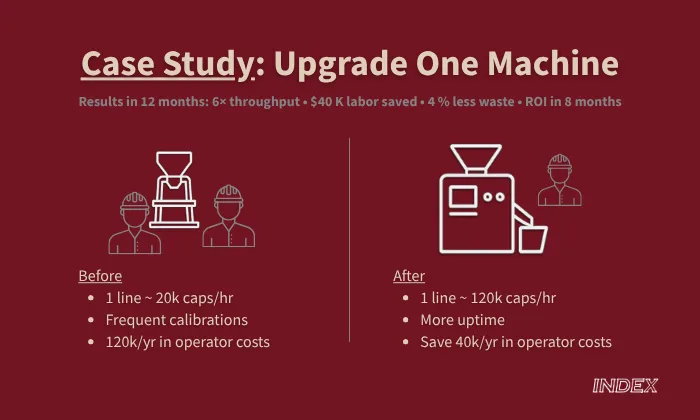
Before/after Infographic of machine upgrade showing 6× output, $40K labor savings, 4% waste reduction, and 8-month ROI.
  • A nutraceutical company operating three capsule filling lines faced recurring downtime and calibration issues, with Line 2 limited to 20,000 capsules per hour.

  • Labor and troubleshooting costs exceeded $120,000 annually.

  • Over the weekend, the team retrofitted Line 2 with the INDEX K120i, a fully automatic capsule filler rated at 120,000 caps/hour to meet demand without adding shifts or headcount.

  • The machine’s advanced servo drives and real-time monitoring enabled ±0.3 mg fill-force precision, eliminating the need for manual calibration.

  • Within 12 months, throughput increased 6×, labor costs dropped by $40,000, and overfill waste was reduced by 4%, saving $20,000 in ingredients.

  • The machine paid for itself in 8.3 months, transforming Line 2 from a bottleneck into a high-speed production asset.

Maintenance and Care for Encapsulation Equipment

Regular maintenance is crucial for maximizing uptime and extending the lifespan of encapsulation equipment. Daily cleaning—especially in pharmaceutical and nutraceutical environments—prevents contamination and keeps machines running efficiently.

Technician in full protective gear inspecting and adjusting stainless steel pharmaceutical equipment in a cleanroom environment.

Regular maintenance is crucial for maximizing uptime and extending the lifespan of encapsulation equipment. Daily cleaning—especially in pharmaceutical and nutraceutical environments—prevents contamination and keeps machines running efficiently.

Operators should follow manufacturer guidelines for inspecting dosing systems, replacing worn seals, and lubricating key components. Many modern machines feature self-diagnostic alerts that help detect issues before they escalate.

Structured maintenance programs and operator training reduce unplanned downtime, improve safety, and ensure consistent performance across shifts, making proactive care a non-negotiable part of reliable production.

Documentation You Can Rely On: Index backs every capsule filler with clear, engineer-ready documentation—exploded-view parts diagrams, calibration protocols, and step-by-step IQ/OQ/PQ guides—so your team can troubleshoot fast and stay audit-ready. Our IQ/OQ templates translate validation into a 48-hour, audit-ready checklist, keeping safety teams satisfied without slowing down the launch. 

Need Help on Site? Our certified field technicians average < 24-hour response times and handle start-up, commissioning, and emergency visits, and every Index filler ships with a signed factory QC report plus an on-site technician sign-off, so your line begins day-one production with verified settings and zero loose parts.

Avoid Start-up Delays: Order the recommended spare-parts kit with your machine so any seal or dosing ring can be swapped in minutes, not days.

Innovation and the Future of Encapsulation Equipment

"Generative AI and big data analytics are transforming pharmaceutical manufacturing and supply chain management.”

The encapsulation industry is evolving rapidly, driven by advances in automation, robotics, and artificial intelligence. Next-generation machines offer adaptive control systems that monitor fill weight in real-time, reduce overfill, and predict maintenance needs using sensor data.

Doctor drawing upward curve labeled pharmaceutical market, symbolizing growth, future trends, and need for encapsulation equipment.

Flexible, modular designs are gaining traction, enabling manufacturers to switch formulations more quickly and scale up without requiring major equipment overhauls. Wear-resistant materials, such as nitride-hardened cams, improve machine longevity, while microencapsulation techniques are expanding their applications in pharmaceuticals, food, cosmetics, and agriculture.

These innovations redefine efficiency, enabling manufacturers to produce more sophisticated, customized products, such as Firmapress®, while reducing waste and operational costs.

Key Takeaways

Encapsulation equipment is no longer a back-end operational choice—it’s a strategic asset that impacts efficiency, product quality, and profitability. Manufacturers who invest in precision, automation, and scalability confidently position themselves to meet rising market demand.

Close-up of automatic encapsulation equipment showing capsule filling station, dosing system, and stainless steel components designed for high-output production.

As the industry shifts toward more innovative, faster, and more flexible solutions, staying current with equipment trends isn’t optional—it’s essential. If you’re evaluating how to improve throughput, reduce costs, or streamline production, now is the time to assess your equipment and process constraints.

Want expert insight on your equipment setup? Our team is ready to help. For over 30 years, Index has offered USA-made capsule filling equipment and on-site customer service, including installation, training, maintenance, and parts, to keep you running smoothly 24/7. Talk to an expert now.

FAQs (Frequently Asked Questions)

What is encapsulation equipment?

Encapsulation equipment is a machine that fills and seals active ingredients into capsules or coatings. Found in pharmaceuticals, nutraceuticals, food supplements, and cosmetics, these machines ensure accurate dosing, protect sensitive materials from moisture and oxygen, and enhance product stability and bioavailability.

Encapsulation in drug delivery is enclosing active pharmaceutical ingredients (APIs) into a protective shell. This process allows accurate dosing, shields ingredients from degradation, supports controlled release, improves therapeutic effect, and patient compliance.

Costs vary based on output, features, and automation. Manual machines typically cost less than $3,000; semi-automatic machines range from $10,000 to $25,000, while fully automatic machines exceed $50,000. High-speed precision machines used in pharmaceutical production, however, are over $100,000 but provide precision, efficiency, and integrated quality controls.

Buying used can be cost-effective, especially when scaling up. But you need to verify the machine’s condition, maintenance history, and compliance with regulatory standards. Work with reputable sellers and look for warranties or rebuild guarantees to minimize risk.

If the frame and core components are sound, rebuilding can extend machine life at a fraction of the cost of new equipment. Upgrading controls, dosing systems, and worn parts can improve performance, output, and compliance without requiring new operator training or layout changes – partner with experienced rebuild specialists to ensure quality and long-term ROI.

Encapsulation machines are often integrated with downstream systems such as capsule sorting, sealing, inspection, and packaging. Automation allows seamless transitions between stages, reducing contamination risk and manual handling. Integration with MES (Manufacturing Execution Systems) also allows real-time monitoring, traceability, and compliance with regulatory standards.

Installation Qualification (IQ) checks that the capsule filler is installed to spec, utilities connected, frame levelled, and software and safety features verified. Operational Qualification (OQ) proves the machine operates within spec, fill weight, vacuum levels, and alarm responses during controlled test batches. Do both before production and you’ll meet regulatory requirements, avoid start-up issues, and have an audit-ready record for engineering and compliance.

Read “Capsule Filling Terms for Manufacturing Professionals,” where we cover the key terms for capsule filling, equipment, and processes to help you communicate to improve performance.

Read More
Man in a blue shirt at a desk comparing two machines—choosing the best automatic capsule filling machine.

Help Choosing the Best Automatic Capsule Filling Machine?

High-speed machines are the game changers in today’s fast-paced nutraceutical and pharmaceutical industries. Imagine turning your product line into a powerhouse of efficiency and quality where every capsule is filled precisely and consistently. We will show you how to choose the best automatic capsule filling machine so you can elevate your operation and remain competitive in the global market.

In this comprehensive article, you’ll learn how these modern innovations help you comply with industry regulations and get actionable tips to optimize your production process. 

Close-up of a stainless steel automatic capsule filling machine for nutraceutical and pharmaceutical production.

Machine Type Comparison: Fully Automatic vs. Semi-Automatic Capsule Filling Machines

Graphic comparison of automatic vs. semi-automatic capsule filling machines with robot arm and human operator icons.

Choosing the right capsule filling machine starts with understanding the differences in performance and automation:

Fully Automatic Capsule Filling Machines

Fully automatic capsule filling machines are for high-volume production; typically, throughput is around 60,000 to 100,000 capsules per hour. They do capsule feeding, dosing, and sealing for you, minimizing manual intervention and giving high throughput, precision, and consistency.

These machines are for large operations that require high speed and strict compliance. The integrated automation increases efficiency and reduces the risk of human error.

Semi-Automatic Capsule Filling Machines

Semi-automatic machines fill 10,000 to 20,000 capsules per hour and offer balanced automation. They automate some processes but have operator oversight, so you can intervene when needed.

This balance is perfect for businesses transitioning from manual to moderate production. You get flexibility and more efficiency than fully manual methods.

Automation in Capsule Filling

Stainless steel automated capsule filling machine labeled "INDEX" for high-volume, precise production and compliance.

Automating production has many benefits for production. Automatic capsule fillers increase output and consistency across every batch.

More Output

Thousands of capsules per hour, so you can scale up to meet high demand without compromising quality.

Better Dosing

Advanced automation means precise dosing and consistent filling, with less chance of errors. The exact amount of active ingredients in every capsule ensures better product quality.

Cost Savings and Labor Reduction

Automating capsule feeding, dosing, and sealing, reduces labor costs. Less manual intervention means allows staff to focus on other areas of responsibility.

Compliance

Automated systems streamline quality control and adhere to industry standards, making compliance easier. They also simplify the audit process and give you peace of mind about product safety and quality.

Choose the Right Capsule Filling Machine

Infographic for choosing the best capsule-filling machine: volume, capsule type, automation, and maintenance.

If you need to fill capsules efficiently and accurately, choose the right capsule filling machine. However, with so many options available, it can be hard to decide, so consider these key points.

Production Volume

Calculate your required output based on daily, weekly, or monthly. Whether you need to fill thousands of capsules an hour or smaller batches, knowing your production requirements will guide you to the right machine.

Capsule Type and Size

Capsules come in different types and sizes, so choosing a machine that can handle your intended capsule type is critical. Hard gelatin capsules are standard, but many modern machines can handle HPMC and Pullulan gum. Some specialty machines, like the Index K120i Capsule Filler, can handle multiple sizes and have upgradeable, interchangeable plates, so you can adapt to changing production needs.

Machine Batch Capacity and Hole Count

The machine’s batch capacity or hole count determines how many capsules can be filled in one batch and impacts production efficiency. For example, a manual machine with 100 holes can fill 400 capsules in 40-60 minutes, while an automatic machine with 400 holes can do the same in 15-20 minutes. Even machines with a batch capacity of one can be efficient when optimized for specific tasks.

Automation Level

Machines range from manual to fully automatic, and the level of automation has a big impact on labor costs and efficiency. Manual and semi-automatic machines require more operator intervention, so they are better for smaller production runs, while fully automatic machines are for high volume with minimal human input.

Power Consumption

Check the machine’s power rating to see if it fits your budget and power supply. Energy-efficient machines can save you operational costs in the long run.

Maintenance and Serviceability

Ease of maintenance and availability of spare parts is a critical factor to consider. Machines designed for quick maintenance with strong support services will minimize downtime and ensure continuous production.

Considering these points, you can choose the right capsule filling machine for your production needs and operation. By doing so, you will integrate the right technology into your production line and set yourself up for long-term success.

Benefits of Automatic Capsule Filling Machines for Nutraceutical and Pharmaceutical Businesses

A blurry pharmacy aisle displays shelves of packaged medications, representing the final output from capsule fillers in pharmaceutical manufacturing.

Automatic capsule filling machines far outweigh manual or semi-automatic systems and are essential for today’s solid dose production. They increase efficiency and ensure quality and compliance.

Faster and Higher Throughput

These machines can process thousands of capsules an hour. The high throughput means you can meet demand without sacrificing quality, and production can scale and be efficient.

Consistent Dosing and Product Quality

Automation delivers precise dosing and capsule filling. Consistency in dosing means no variability between batches, and every capsule meets quality standards and regulatory requirements.

Reduced Labor Costs

These machines reduce manual labor by automating capsule feeding, dosing, and sealing tasks. Less labor means lower costs and more manpower to focus on other production areas.

Simplified Quality Control and Compliance

Automatic systems have quality control measures like real-time monitoring and data logging. These features make it easy to comply with GMP guidelines and other industry regulations, simplify product audits, and make them safer.

Increased Operational Efficiency

High speed and precision dosing reduce labor, increasing operational efficiency. This lowers costs, produces less waste, and a competitive edge over the competition.

Adding automatic capsule filling machines to your production line can increase productivity, quality, and cost savings—the keys to long-term success in the nutraceutical and pharmaceutical industry.

Industry Compliance and Quality Standards

Close-up of a Quality Assurance document with icons symbolizing compliance and standards in nutraceutical/pharmaceutical industries.

Industry compliance and quality control are crucial for the safety and efficacy of nutraceuticals and pharmaceuticals. Modern capsule filling machines are designed to meet these requirements, ensuring quality and peace of mind.

Global Benchmarks

These machines are built to global standards and GMP guidelines. Their smooth, easy-to-clean surfaces and automated dosing systems minimize contamination risks and ensure that every capsule meets quality control.

Real-Time Monitoring and Data Logging

Integrated systems provide real-time monitoring and data logging, which is essential for quality. This continuous oversight makes auditing and compliance with regulations much easier, and you can show compliance during inspections.

Documentation and Traceability

With detailed batch documentation and traceability, these systems help manufacturers meet local and international market demands. The data generated is reliable and enables quick corrective actions if issues arise, ensuring compliance and overall quality.

With all these features, automatic capsule filling machines increase production efficiency, and every product meets industry standards and quality benchmarks.

Global Market and Various Industries

A light-colored world map with connected lines, illustrating global reach and industry impact of automatic capsule filling machines.

Automatic capsule filling machines are key to production efficiency and profoundly impact global markets and industries. They help manufacturers confidently enter new markets.

Global Reach

These machines help manufacturers meet the high demands of international markets by producing high volumes of consistent quality. Scaling up without compromising quality is key to staying ahead of the competition and going global.

Various Industry Applications

Automatic capsule filling technology is widely used in the nutraceutical, pharmaceutical, cosmetic, and chemical industries. For nutraceuticals manufacturers, it enables consistent production of health supplements with accurate dosages and quality control. Pharmaceutical producers benefit from precise dosing and strict regulatory compliance. Cosmetic brands use it to produce beauty supplements and skincare products with high consistency and customer satisfaction. Chemical formulators must handle chemicals safely while meeting stringent safety standards.

Adapting to Market Changes

The scalability of automatic capsule filling machines allows businesses to adapt quickly to market changes. Their versatility enables companies to adjust production volume and product offerings as consumer demands evolve. This flexibility is crucial for long-term growth in a global market.

By using an advanced capsule filling technology, manufacturers can increase operational efficiency and become more competitive globally. These machines are necessary for businesses looking to go global and produce high-quality products.

Customization, Scale, and Integration

Person in business attire touching rising arrows, symbolizing growth, scalability, and integration for capsule filling production.

Good capsule filling requires flexible machines that integrate seamlessly into your production process. Here’s what you need to achieve maximum flexibility and efficiency on your production line.

Production Scale

Filling machines are designed to work on different production scales.

For small volumes, cost-effectiveness and flexibility are perfect for startups and low-volume production.

For medium volume, systems balance throughput and flexibility and support growing production without overwhelming the operator.

For large volumes, high-speed, high-capacity machines are built to run with minimal downtime and perform under heavy demand.

Customization

Customization is key to choosing the right capsule filling machine.

Many machines have quick changeovers; you can switch between capsule sizes and formulations with minimal effort.

Machines with user-friendly interfaces and adjustable settings make it more versatile. Operators can fine-tune processes to specific production needs, allowing the machine to adapt to market trends and business needs.

Integration

Seamless integration with other production line components is key to efficiency.

Modern capsule filling machines are designed to connect with mixers, conveyors, and packaging systems for a smooth workflow. They also integrate real-time monitoring and data management systems for traceability and regulatory compliance, making your production transparent and controllable.

Focusing on production scale, customization, and integration allows you to tailor your capsule filling system to your operation. This approach will ensure efficiency and the ability to adapt to market changes, which is essential for long-term success.

Technical & Operational Considerations

Two lab-coated operators in hairnets and masks reviewing plans in a manufacturing facility for capsule filling production.

Capsule filling is all about technical design and operational know-how. This section covers the important bits that make it perform and work smoothly.

Operational Efficiency & Energy Management

Machines with energy-saving features and quiet operation cost less to run, making the work environment more comfortable. Energy efficiency also reduces utility bills and is better for the planet.

Tough Construction & Durability

High-quality materials and precise engineering ensure these machines can withstand continuous use and performance. Their robust construction also means less wear and tear, fewer repairs, and a longer equipment life.

Maintenance Strategies & Cost-Effectiveness

Good maintenance is key to high production. Machines with easy component access and modular upgrades minimize downtime and long-term costs and ensure production doesn’t stop.

Safety Features & Operator Protection

Safety is paramount in any factory. Emergency stops, interlocks, and ergonomic design protect the operator and meet industry standards, making the workspace safer and reducing accidents.

Support, Spare Parts, and Service Reliability

Bearded support specialist wearing a headset, providing reliable customer service for capsule filling solutions.

Choosing the right supplier for support, spare parts, and service reliability is key to your production line running without interruptions.

Partner with Experts to Overcome Challenges and Uptime

Look for companies with solid encapsulation expertise and a track record for reliability. Established manufacturers offer high-performance automatic capsule filling machines and good customer service that can sort out issues fast, with minimum downtime.

Technical Support is Key

Technical support is vital in today’s manufacturing world. Manufacturers that provide on-site training, proactive troubleshooting, and preventative maintenance checks will keep your machines in top condition, reducing costly downtime and extending the life of your equipment.

Spare Parts for Minimal Downtime

Access to a complete inventory of spare parts is crucial for continuous production. Immediate availability of critical components will quickly resolve mechanical issues, reducing downtime and keeping production schedules on track.

Service Reliability and Customer Satisfaction

Consistently good service is key to long-term production efficiency. Suppliers that integrate issue resolution, maintenance, and customer feedback into their service protocols build trust and deliver a better customer experience, which benefits the overall business.

Choosing the Right Manufacturer for Your Capsule Filling

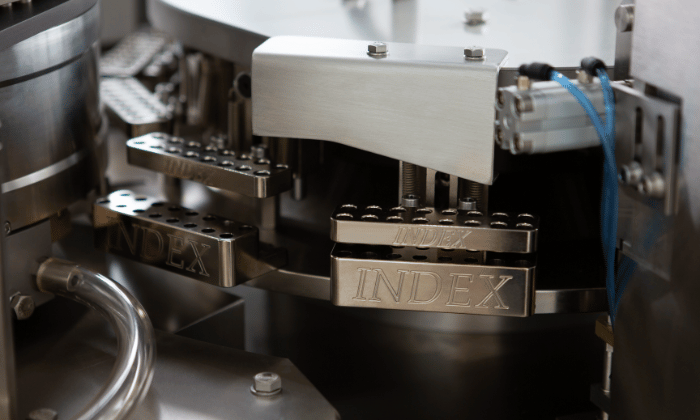
Close-up of an INDEX stainless steel capsule filling machine, emphasizing advanced manufacturing and reliability.

Choosing the right manufacturer for your capsule filling is key to getting a high-quality machine that meets your needs. This section provides practical tips to help you find a reliable supplier to support your production.

Research and Reputation

Research the manufacturer’s reputation, experience, and track record. Established manufacturers with a history of excellence are more likely to produce reliable, high-performance machines, so you can be confident in your investment.

Product Range and Versatility

Make sure the manufacturer has a range of machines to cover different production needs. A broad product portfolio that includes different capsule types, sizes, and levels of automation is a good indicator of the manufacturer’s ability to meet different market requirements.

Customer Support and After-Sales Service

Customer support is a major factor in choosing a manufacturer. Look for companies that offer technical support, maintenance service, and readily available spare parts. This commitment to service means minimal downtime and peak performance.

Certifications and Compliance

The manufacturer must comply with certifications and standards such as cGMP and ISO 9001. Meeting these standards means the machines are built to meet strict quality and safety requirements, giving you extra assurance for your production line.

Conclusion: What is Excellence in Automatic Capsule Filling Technology

Grey-haired businessman in a suit shakes hands with a lab professional, symbolizing success in capsule filling technology.

Choosing the right automatic capsule-filling machine is more than just about speed. It’s about combining technology to achieve precise dosing, efficiency, and compliance. This conclusion summarizes the importance of quality, consistency, and innovation in modern solid dose manufacturing.

Key Features and Performance Metrics

Automatic capsule filling machines are designed for precision and reliability. They deliver accurate dosing through advanced mechanics and reduce operational costs with energy-efficient designs and high production volumes through continuous operation. These features set the standard for quality and consistency, making them a must-have for large-scale solid dose production.

Final Thoughts on Innovation in Capsule Filling Equipment

Better capsule filling technology drives innovation in the industry by increasing production efficiency and product quality. Investing in advanced automated systems improves processes and helps companies stay ahead in a rapidly changing market. This is key to reducing waste, optimizing operations, and staying in the lead.

Future Trends and Evolving Technologies

The future of capsule filling technology is going to be big. Emerging trends include AI for predictive maintenance, real-time monitoring, and energy efficiency. As manufacturers develop machines that can handle multiple formulations, these trends will drive operational excellence and product quality.

Frequent Asked Questions

Manual capsule filling machines are the most affordable option but require significant time and labor, which increases operational costs. As production demands rise, semi-automatic machines can produce between 10,000 and 20,000 capsules per hour, although they still require operator input. In contrast, fully automatic systems can generate between 12,000 and 450,000 capsules per hour with minimal human intervention, making them the modern standard for high-volume production.

Transitioning to automatic is best when production volume exceeds what manual or semi-automatic machines can handle. This is especially important when accuracy, speed, and compliance with industry standards become top priorities for your operation.

Automatic machines use dosing discs and tamping pins to fill each capsule uniformly. This precision guarantees accurate dosing, increases throughput, reduces labor costs, and improves production efficiency.

Yes. Many modern capsule filling machines are designed to meet or exceed industry regulations, including GMP guidelines. Their design and operating protocol are aligned with global quality standards to ensure product safety and consistency.

Start by assessing your current production needs. A manual or semi-automatic machine might be enough for small-scale production. But if you are scaling up, look for automatic machines that can produce high throughput, be customized for different capsule sizes, and seamlessly integrate with your existing production process.

Modern machines can handle different capsule sizes (hard gelatin capsules) and filling materials (powders, liquids, etc.). Many machines have a user-friendly interface and quick changeover capability, so you can adjust the production line to match different packaging and formulation requirements.

Production speed, dosing precision, energy efficiency, noise level, and overall durability are essential for continuous and reliable operation. Features like a robust safety system (emergency stops, interlocks, etc.) and ease of maintenance are also crucial.

Top manufacturers provide technical support, including on-site training, spare parts availability, control system upgrades, and rebuilding services. These services are crucial for maintaining uptime and ensuring equipment runs at optimal performance in the long term.

Machines for liquid filling are often liquid capsule fillers. Some fully automatic capsule filling machines can handle powders and liquids. However, when precision dosing of liquid formulation is critical, manufacturers usually offer dedicated liquid filling machines that guarantee accurate dosing and quality.

While both aim to improve production efficiency, the main difference is the level of automation. Semi-automatic machines require manual intervention for tasks like capsule placement or material loading, which can limit the throughput. Fully automatic machines perform most steps—from capsule feeding to dosing and sealing—with minimal human input to achieve higher speed and consistency.

Costs vary widely depending on production capacity, level of automation, and machine features. Entry-level or manual systems can cost a few thousand dollars, while high-performance fully automatic machines can cost several hundred thousand dollars. It is best to consult manufacturers or suppliers for pricing tailored to your production needs.

Read More
An image of a hand holding a capsule filling regulatory compliance seal-of-approval badge against a blue background.

Regulatory Compliance for Manufacturing with Capsule Filling Machines: What You Need to Know

Table of Contents

With ingestible products, such as encapsulated supplements or medication, regulatory compliance is a non-negotiable requirement for manufacturers. Ensuring that capsules meet safety and quality standards is critical for protecting consumers while maintaining trust and a good reputation in the industry.

Regulatory bodies, like the FDA (Food and Drug Administration) and international compliance organizations have created clearly defined standards for manufacturing with capsule filling machines, quality control, and distribution. These regulations are designed to avoid product contamination, promote ingredient transparency, and maintain consistent product quality while manufacturing with capsules.

Adhering to cGMP (Current Good Manufacturing Practices) and other compliance standards is more than just required by law– it’s also an important part in manufacturing reliable, high-quality capsule products that meet both industry expectations and consumer safety standards. Manufacturers have a lot to lose if they fail to comply: costly recalls, legal consequences, and damage to their brand reputation.

Because of these risks, keeping ahead of these mandatory standards will help manufacturers optimize their processes, prevent errors in capsule filling, and maintain trust in the products they make. Regulatory standards are involved in many aspects of manufacturing with capsules, including ingredient procurement, capsule filling machine compliance, quality assurance, and other relevant requirements.

Major Regulatory Bodies and Standards Involved in Encapsulation

Encapsulated supplement and pharmaceutical manufacturers must follow stringent regulatory guidelines to ensure product safety, consistency, and legal compliance. Several governing bodies create these regulations, with each playing an important role in supervising various parts of capsule production.

FDA (Food and Drug Administration) - U.S. Regulation for Encapsulated Supplements and Pharmaceuticals

A pile of capsule supplements in front of supplement product bottles, with their supplement facts data label facing forward.

In the United States, the FDA is the major regulatory authority in charge of supplement and pharmaceutical manufacturing, labeling, and distribution. 

  • Under 21 CFR Part 111, the FDA enforces cGMP for dietary supplements, requiring manufacturers to ensure identity, purity, strength, and composition of their products.
  • Pharmaceutical manufacturers must adhere to 21 CFR Parts 210 and 211, which establish cGMP standards for medication production, quality control, and testing.
  • For consumers’ safety, the FDA also checks for adverse events, ingredient safety, and accurate labeling practices.

Failing to comply with FDA standards can have major repercussions, including product recalls, warning letters, fines, and even facility shutdowns. To be successful in manufacturing, it is vital to strictly adhere to their standards.

cGMP (Current Good Manufacturing Practices) - Ensuring Consistent Quality and Safety

The cGMP requirements ensure that capsule manufacturing methods consistently produce safe, high-quality products that meet industry standards. These guidelines include:

  • Facility cleanliness and contamination control
  • Equipment maintenance and validation
  • Raw material testing and supplier verification
  • Batch production records and documentation
  • Quality assurance and finished product testing

cGMP compliance is not just a legal requirement but a best practice for maintaining a strong reputation in the nutraceutical and pharmaceutical industries.

ICH (International Council for Harmonisation) - Global Pharmaceutical Guidelines

The International Council for Harmonisation (ICH) creates harmonized recommendations for pharmaceutical manufacturers around the world, assisting in the streamlining of regulatory standards across borders.

  • ICH guidelines concern medicine safety, efficacy, and quality across the whole product lifecycle.
  • For capsule manufacturers exporting to multiple markets, ICH compliance ensures consistency in testing, formulation, and production.
  • Stability testing, impurity limitations, and quality risk management are among the most important ICH guidelines.

Manufacturers seeking to distribute their products globally must follow ICH recommendations to gain market access in Europe, Japan, and other regulated regions.

NSF/ANSI Standards - Third-Party Certifications for Supplement Safety

The NSF/ANSI (National Sanitation Foundation/American National Standards Institute) standards are third-party certification systems that ensure supplement manufacturers satisfy rigorous safety and quality standards.

  • NSF/ANSI 173 is the primary standard for dietary supplements, ensuring products are free from contaminants and misleading label claims.
  • Manufacturers who achieve NSF certification demonstrate a commitment to quality and regulatory compliance, improving consumer trust.
  • These standards go beyond FDA requirements, offering an additional layer of credibility in the supplement industry.

Many retailers and customers choose supplements based on their NSF certification, making compliance critical for brand reputation and sales growth.

EU Regulations - Compliance for International Markets

Manufacturers who want to sell capsule-based products in Europe must follow European Union (EU) laws, which differ from U.S. FDA restrictions.

To avoid any possible setbacks, import restrictions, and legal penalties, capsule manufacturers exporting to EU nations must first understand and implement local compliance requirements.

Capsule Filling Machine Compliance

Compliance in capsule manufacturing includes not just ingredient safety and product quality, but also equipment safety, sanitation, and operator protection. Capsule filling machines, capsule polishing machines, and other encapsulating equipment must adhere to regulatory requirements to ensure safe, efficient, and contamination-free production.

An overview of a pharmaceutical manufacturing facility, with a machine operator wearing PPE taking notes to maintain regulatory compliance.

Regulatory Requirements for Capsule Filling Machines

Manufacturers must make sure that their capsule filling machines comply with:

Like the capsule filling machine regulation covered in the previous section, failure to meet these standards may result in regulatory penalties, production shutdowns, and potential recalls.

Capsule Filling Machines & Compliance Considerations

Capsule filling machines require accurate calibration to help facilitate:

  • Accurate Capsule Weight and Fill Volume – Preventing dosage inconsistencies that are non-compliant and could lead to product recalls.
  • Easy Cleanability & Material Safety – Equipment must be made from FDA-compliant, non-reactive materials (e.g., stainless steel) and be easily sanitized to prevent cross-contamination.
  • Automation & Process Control – Modern equipment should include automated weight verification and batch tracking for compliance with pharmaceutical regulations.

Nutraceutical manufacturers must also comply with ISO 22000 and NSF/ANSI supplement standards to ensure their encapsulated products are safe to consume.

Capsule Polishers and Other Capsule Filling Auxiliary Machines

Capsule filling auxiliary equipment such as capsule polishers, dust separators, empty capsule eliminators, vacuum capsule loaders, and vacuum powder loaders also play an important role in regulatory compliance. Some processes they are involved in are:

  • Debris Removal – Effectively eliminating excess powder and particles to meet hygiene and regulatory standards.
  • Capsule Sorting & Rejection Systems – Machines should include automated quality control features to identify and reject defective capsules.

Minimizing Cross-Contamination – All equipment should be easily sanitized between batches, reducing the risk of ingredient cross-contamination.

Operator Safety & Workplace Compliance

In any manufacturing environment, operator safety is paramount. Due to their being high-speed and having several moving parts, capsule filling machines should include:

How to Avoid Common Capsule Manufacturing Compliance Issues

Maintaining regulatory compliance in capsule manufacturing means rigorous quality control, sustaining documentation, and consistently performing capsule filler machines maintenance. Failure to follow these regulations may result in product recalls, legal penalties, and interruptions in operations. The following are some of the most prevalent compliance difficulties and how to prevent them.

A closeup shot of documentation paperwork displayed in a table format.

Poor Product Quality Due to Lack of Proper Documentation

cGMP requires both pharmaceutical and supplement manufacturers to document every step of production to ensure consistency and traceability. Besides this, proper documentation can also  potentially help prevent wasted product during manufacturing. These challenges can happen with poor maintenance of documentation:

  • Variations in capsule weight, fill volume, and formulation.
  • Inconsistencies between batches, which can have an impact on bioavailability and safety.
  • Difficulties in tracing problems during recalls or audits.

How to Avoid Documentation Challenges:

Equipment Failures Resulting in Regulatory Violations

To comply with regulatory standards, capsule filling, polishing, and other related machines must operate reliably and consistently. Equipment failures can lead to:

  • Inconsistent capsule weight and dosage, making them non-compliant.
  • Cross-contamination risks because of inadequate cleaning or dust extraction.
  • Delays in batch yields and reporting due to production downtime.

How to Avoid Equipment Failures:

  • Develop a preventative maintenance procedure for all capsule filling machinery.
  • Conduct regular calibration to ensure consistent weight, fill volume, and sealing.
  • Keep detailed maintenance logs to show compliance during inspections.
  • Use high quality machine parts and replace them before they are damaged.
A closeup shot of white filled capsules enclosed in a foil package.

Final Thoughts on Regulatory Compliance with Capsule Filling Machines

To guarantee product safety, quality, and industry credibility, regulatory compliance in capsule manufacturing should absolutely be prioritized. Every step of the capsule manufacturing process must follow  regulatory standards to prevent recalls, legal issues, and delays in manufacturing. With focusing on compliance, manufacturers can optimize production while upholding product quality standards.


Anticipating compliance issues before they happen can help lead to efficient operations, consumer safety, and long-term success in pharmaceutical and nutraceutical manufacturing. Get in touch with the capsule filling experts at Index today to learn more about our encapsulation machinery that is fully compliant with a number of regulatory standards. Our team can help you find the right capsule filling equipment to meet your production needs while ensuring compliance with FDA, OSHA, cGMP, and other regulatory requirements.

Read More
Close up shot of a pile of white capsules.

Essential Capsule Filling Terms for Manufacturing Professionals

Understanding Capsule Filling: Key Terms and Equipment

Manufacturing high-quality encapsulated products involves specialized encapsulation equipment and knowledge of precise terminology. Here’s a clear list of essential capsule filling terms, organized by relevant categories, to help you select the best machinery and capsule filling parts for your production needs.

Parts of the Capsule

Capsule Body
The longer part of the capsule shell that holds the product before sealing.

Capsule Cap
The shorter section of the capsule shell that fits over the body, sealing the contents.

Active Pharmaceutical Ingredient (API)
The primary substance within a capsule responsible for its intended effect.

Excipient
Inactive ingredients that help the active ingredient flow through the machine and into capsules and reduces how much they stick to the tamping pins and segment plates.

A close up shot of a person holding a white capsule, showing the capsule body and capsule cap.

Capsule Filling Machine Equipment

Capsule Filler
Machinery used to accurately fill empty capsules with powders, liquids, or pellets. Index provides high-end, precision-driven capsule fillers ideal for high-volume manufacturing.

Semi-Automatic Capsule Filler
Machines requiring partial operator involvement, suitable for smaller batch sizes or specialized products.

Fully Automatic Capsule Filler
Fully automated, high-capacity capsule filler machine designed for large-scale, continuous production with minimal operator intervention, typically suited for high-end production.

Dosator
A precise mechanism within high-end capsule fillers that accurately measures and delivers powder or granules into capsule shells.

Tamping Pins
Tools used in capsule filling machines to compress powder into capsules, ensuring consistent fill weights and uniformity. Tamping pins are not used in dosating capsule filling machines. Index offers specialty capsule filler tooling to prevent sticking.

Hopper
Container on a capsule filling machine that holds powder, pellets, or granules, feeding them into the filling mechanism.

A photo of an Index capsule filling machine. It is the fully automatic capsule filling machine called the K120i

Capsule Filling Processes & Techniques

Fill Weight
The exact amount of material placed inside each capsule. Index capsule filling machines offer highly accurate fill-weight control.

Pellet Filling
The process of filling capsules with small spherical granules or pellets, used for controlled-release formulations.

Powder Flowability
How easily powder moves within a machine, critical for consistent capsule filling and dosing accuracy.

Capsule Filling Machine Components & Accessories

Change Parts
Specific interchangeable capsule filler parts required to adapt machines to various capsule sizes, facilitating flexibility and efficiency.

Tooling
Capsule filling tooling are customized mechanical parts, including dosing disks or filling segments, that ensure accurate capsule filling in high-quality machines.

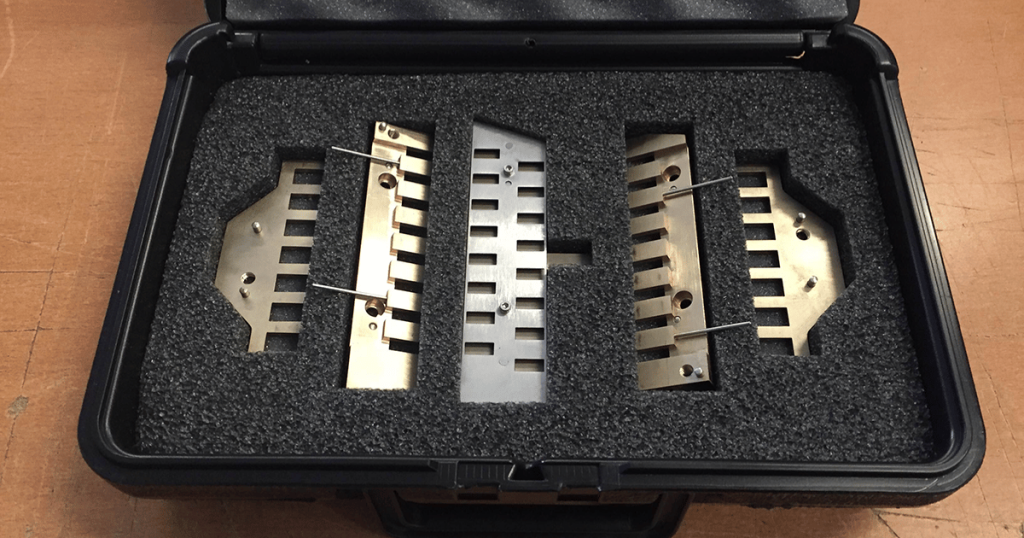
A toolbox containing Index capsule filling machine spare parts.

Quality Assurance in Capsule Filling

Validation
The process of documenting that capsule filling equipment consistently produces capsules meeting predefined specifications.

In-Process Control (IPC)
Regular quality checks performed during encapsulation to ensure consistency, quality, and regulatory compliance.

Weight Variation
The acceptable range of weight differences between filled capsules, which affects quality control and regulatory compliance.

Powder Flowability
How easily powder moves within a machine, critical for consistent capsule filling and dosing accuracy.

Two capsule filling machine operators wearing PPE, holding clipboards, and performing quality assurance testing.

Regulatory Compliance in Capsule Filling

cGMP (Current Good Manufacturing Practices)
Regulatory guidelines ensuring that encapsulated products are manufactured under controlled, quality-assured conditions. Index machines comply fully with cGMP standards.

Validation
The process of documenting that capsule filling equipment consistently produces capsules meeting predefined specifications.

In-Process Control (IPC)
Regular quality checks performed during encapsulation to ensure consistency, quality, and regulatory compliance.

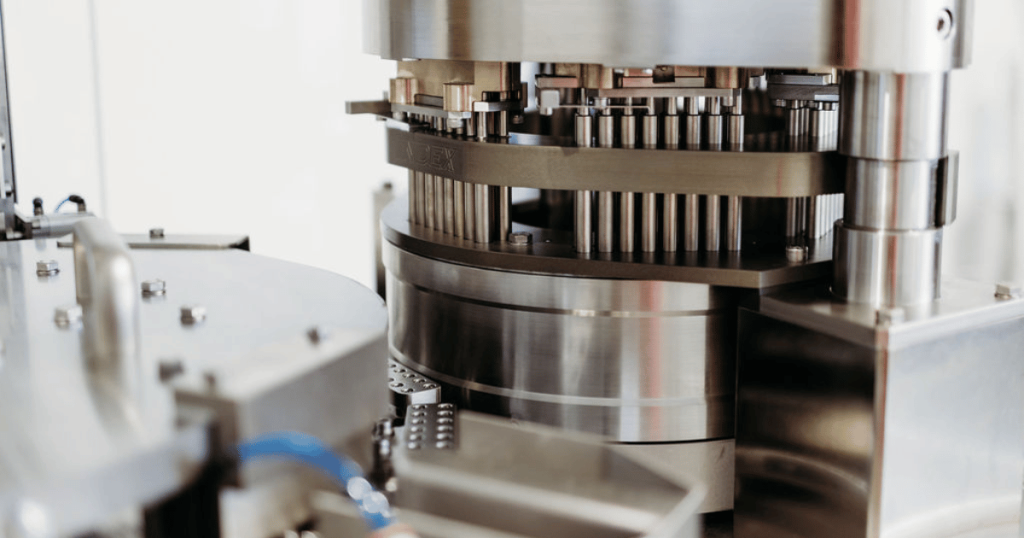
A close up shot of the Index K120i capsule filler machine tamping pins in the tamping section.

By familiarizing yourself with this terminology, you’ll enhance communication, improve operational performance, and confidently select machinery that aligns with your company’s specific production goals.

For guidance in selecting the right encapsulation machinery or assistance optimizing your capsule filling processes, contact Index today. Our experts are ready to help with all your encapsulation needs.

Read More
A warehouse technician managing capsule spare parts inventory with a tablet device.

Why Investing in Capsule Filler Spare Parts Matters

With manufacturing, one of the biggest risks that can cost businesses money is downtime. When production comes to a full stop due to a broken capsule filler part, there’s delays, which in turn results in financial loss and decreased customer satisfaction. To help prevent any interruptions, manufacturers should be proactive by keeping capsule filler spare parts on hand. Although it might seem redundant, keeping extra capsule filler spare parts readily available enables manufacturers to quickly resolve machine issues, reducing the length of production delays and their negative consequences. Further exploration into the financial implications of downtime in capsule manufacturing can reveal how a well-stocked capsule filler spare parts inventory can mean cost savings, improved operational efficiency, and optimal production.

The True Cost of Downtime

Downtime in capsule manufacturing refers to the period of time in which manufacturing halts due to a machine’s failure or it requiring maintenance. It is an issue that affects several sectors of manufacturing, however. In a recent 2024 study, Siemens uncovered some concerning data regarding manufacturing downtime in different sectors. For small to mid-scale manufacturing, downtime can be significantly harmful, with costs up to $150,000 per hour, risking unsustainable financial strain and loss of business.

There are very real potential consequences from downtime due to a machine requiring capsule filler spare parts.

Lost Production and Financial Impact

When manufacturing is interrupted, the immediate result is the loss of product output. This affects your product availability, which hurts revenue and can put a strain on customer relationships. For example, if a nutraceutical company experiences a day of downtime due to a damaged dosing disc in their capsule filling machine, their production can be delayed. This can lead to contract penalties or even missed sales opportunities. The financial impact can even extend beyond lost sales; idle labor costs, wasted materials, and energy expenses are some examples of other financial losses.

Higher Expenses Due to Repair Costs

Preemptively stocking your capsule filler spare parts inventory can prevent unexpected machine failures and even save some money in the long run. Emergency repairs can be more expensive, due to the urgency in ordering the capsule filler spare parts. This requires expedited shipping and sometimes higher labor costs. For another example, imagine a manufacturer who waits a little too long to replace a worn-out dosing disc suddenly experiences a machine breakdown because of it. The repair requires more expensive overnight shipping, which adds even more to the cost of production downtime.

Negative Brand Reputation and Customer Dissatisfaction

Reliable delivery is a critical factor in the pharmaceutical and nutraceutical industries. Downtime delays are a real threat to these manufacturers and have the potential to damage customer relationships, leading to lost business and contracts. There is also the matter of competitive disadvantage due to unreliable deliveries. If a manufacturer is unable to deliver on time, they risk their market position. This gives competitors a convenient window of opportunity to solve their frustrated customer’s pain points that have stemmed from their manufacturing inconsistencies.

Close up of Index K120i capsule separating section.

Building an Effective Spare Parts Inventory

A sure way to reduce downtime is by investing in a stock of capsule filler spare parts. By maintaining a well-stocked and organized inventory of spare parts critical for machine operation, manufacturers can prevent small issues from escalating into major interruptions.

Factors to Consider When Identifying High Priority Spare Parts

Not all of the spare parts for a capsule filling machine are equal in value when it comes to successful operation. The most critical capsule filler spare parts are those that are essential to the machine’s functioning. When determining critical capsule filler spare parts, keep these factors in mind:

  1. Frequency of Wear: Parts that experience high levels of friction, pressure, or heat should be replaced often.
  2. Machine-Specific Parts: Different capsule filling machines may require unique parts. Consult the machine’s manual and manufacturer’s recommendations for high-priority capsule filler spare parts.
  3. Lead Times for Procurement: Some stock parts may be difficult to source, so take consideration of possible long lead times and delivery to avoid prolonged downtime.

Best Practices for Stocking and Managing Spare Part Inventory

Even with the critical parts identified, an effective inventory system ensures those parts are available when needed. Proper management of spare part stocks can prevent last-minute orders and any expenses associated with it. Here are some best practices:

  1. Inventory Categorization: Organize capsule filler spare parts by priority, how often they are used or replaced, and compatibility.
  2. Regular Audits: Perform regular inventory audits to ensure important items are in stock and obsolete parts are removed.
  3. Storage Conditions: Store capsule filler spare parts in environments that prevent damages, such as dry, clean, and temperature-controlled spaces.
  4. Reliable Capsule Filler Spare Parts Suppliers: Partner with a trusted capsule filler spare part supplier for quality assurance and reliable delivery schedules.

Balancing Costs and Benefits

The cost of investing in spare parts can seem high at first glance, but this is ultimately a strategic approach with long-term value. Balancing upfront costs with future savings ensures the investment makes the best financial sense.

A person analyzing ROI data and charts.

Justifying Upfront Costs to Decision-Makers

To get buy-in, it’s important to show stakeholders that investing in spare parts reduces downtime, prevents costly emergency repairs, and supports smoother production. Use specific examples and data to show the benefits.

ROI on Spare Part Investments

You can quantify the return on investment by comparing downtime costs avoided to the cost of maintaining an inventory. For example, preventing two downtime events costing $50,000 each with a $10,000 spare parts investment results in substantial ROI.

Training Team Members for Maintenance and Capsule Filler Spare Parts Inventory

A good spare parts inventory is only as effective as the team managing it. With proper training, your staff can know how to identify, store, and replace critical components efficiently. Empowering your team with knowledge can make the most of your spare parts strategy.

Two people participating in capsule spare parts training.

Why Does Training for Capsule Filler Spare Parts Inventory Matter?

A trained team is essential to get the most value out of your spare parts inventory. Without proper knowledge, even having the right parts available won’t prevent downtime or errors.

  • Reduces Replacement Errors: Trained staff can identify and install the correct spare parts quickly, avoiding mistakes and even further downtime delays.
  • Improves Inventory Management: A team that understands the capsule filler spare parts and their order of importance for operation can better maintain and track inventory.
  • Boosts Capsule Filler Longevity: Knowing when and how to replace parts helps prevent unnecessary wear on encapsulation machinery.

What Are Some Important Training Topics for Capsule Filler Spare Parts Inventory?

To empower your team, focus training on essential areas related to spare part management and capsule filling machine maintenance.

  • Part Identification: Help staff recognize high-priority parts and understand their functions.
  • Inventory Systems: Teach team members to use tools or systems to track stock levels and manage reordering.
  • Replacement Procedures: Establish clear instructions on safely and efficiently replacing capsule filler spare parts to minimize downtime.

With the right training, your team can ensure that your capsule filler spare parts strategy works as best it can. A knowledgeable team keeps your operations running efficiently, lessens errors, and extends the life of your capsule filling machines. This investment in training is an important step toward minimizing downtime and maximizing productivity.

Downtime in manufacturing with capsule filling machines can have costly repercussions, but it can be effectively taken care of with the right approach. Investing in a well-stocked and organized inventory of capsule filler spare parts, along with properly trained teams, helps ensure smooth operations, reduced downtime, and consistent production. By proactively addressing potential issues with readily available parts, manufacturers can save money, improve operational efficiency, and maintain customer satisfaction.
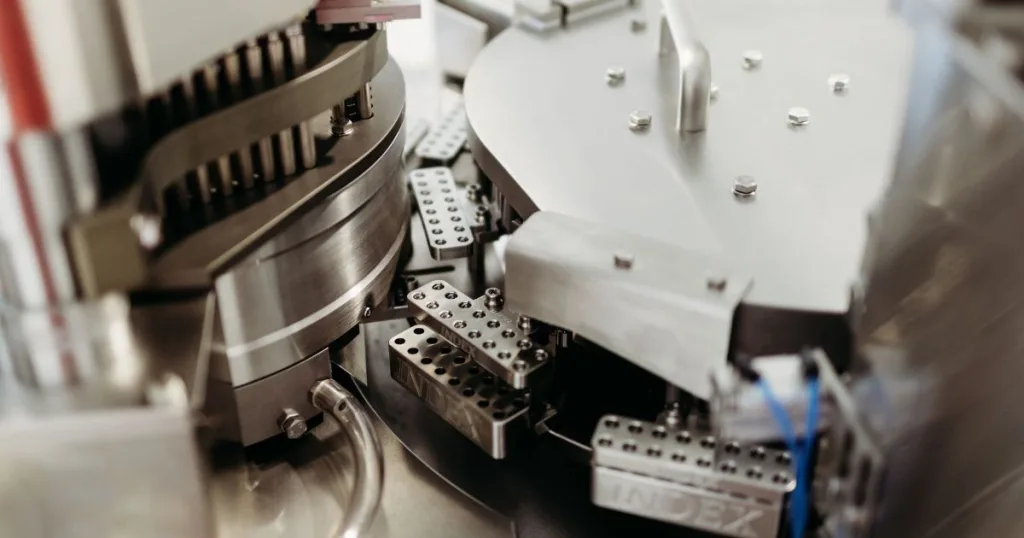
Don’t let downtime hurt your productivity or reputation. Contact Index Capsule Fillers today to explore our range of high-quality capsule filler spare parts and learn how we can support your manufacturing needs. We have a full inventory of capsule filler spare parts ready to be shipped to you when you need them. Contact our encapsulation experts today, and we can help you build an effective spare parts strategy to keep your operations running smoothly.

Read More